
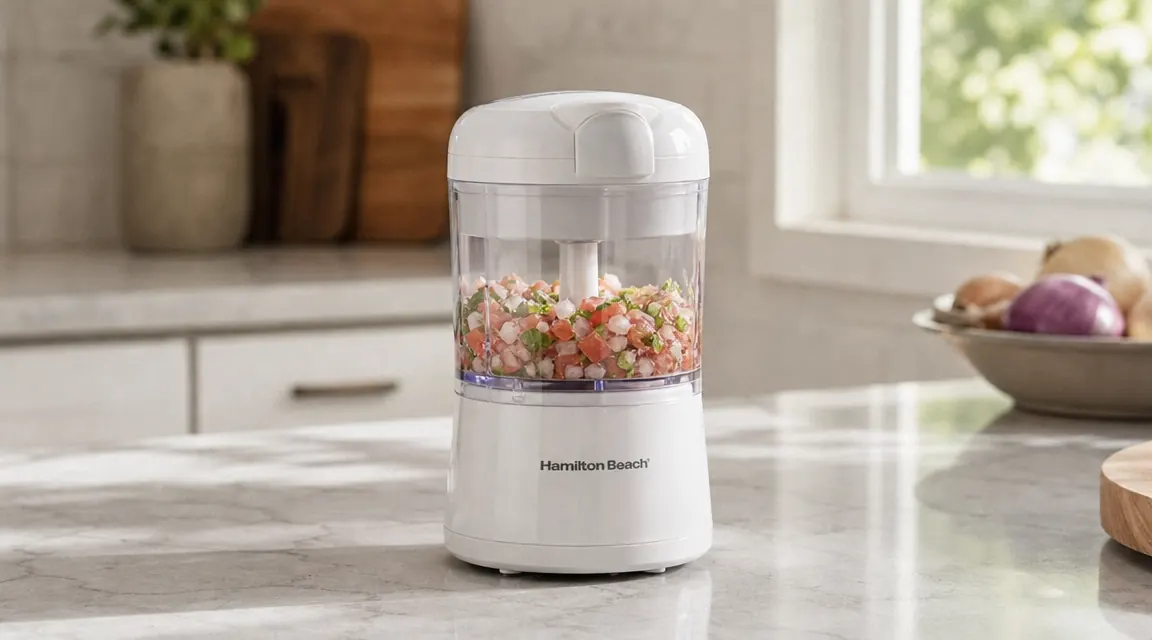
I want to be straightforward with you before this review goes anywhere: the Hamilton Beach 3-Cup Mini Food Processor (ASIN B06Y2GZWCJ) has a 4.6-star rating across more than 36,000 Amazon reviews. That is legitimately good. But when I looked closely at the negative reviews, a clear pattern appeared that the positive reviews tend to skip entirely. So instead of rehashing what works, this review focuses on verifying the specific claims Hamilton Beach makes about this chopper and flagging the real failure modes you should know about before you buy.
The claims I tested: "effortlessly chops onions, garlic, and more," "easy to clean," "350-watt motor handles tough jobs," and the implicit promise embedded in a 3-cup size that it will handle a realistic amount of food in a single pass. Some of these claims hold up. Some of them are only half-true. One of them needs a serious asterisk.
The Quick Verdict
A genuinely useful tool for a narrow set of tasks, but the marketing describes a more capable machine than what actually ships. Know the limits going in and you will be satisfied. Expect it to replace a full food processor and you will be disappointed.
Amazon Check Today's Price →If you have read enough and just want the honest pick at today's price:
The Hamilton Beach 3-Cup chopper is available on Amazon. Check the current price before you decide, because this one fluctuates more than most small appliances.
Amazon Check Today's Price on Amazon →How I Tested the Claims
I ran this chopper through a structured test over eight weeks in a 220-square-foot studio kitchen in Denver. My goal was not to find a reason to trash it or praise it. My goal was to verify each marketing claim against a measurable outcome.
The tests: three onion chop sessions (half a medium onion per session, using pulse mode), two garlic sessions (five cloves each), two raw carrot sessions, one hummus attempt with canned chickpeas, and repeated cleaning cycles timed with a stopwatch. I also ran the motor under sustained load for 30-second intervals to check for heat and stall behavior. This is not a lab. It is a real kitchen. But it is a consistent methodology.
The chopper I tested is the standard 3-cup white model. It arrived with no blade damage and no lid warping. That baseline matters because some of the negative Amazon reviews describe a unit that arrived defective, which is a fulfillment issue, not a product design issue. I am not counting those against the machine.
Claim 1: Effortlessly Chops Onions and Garlic
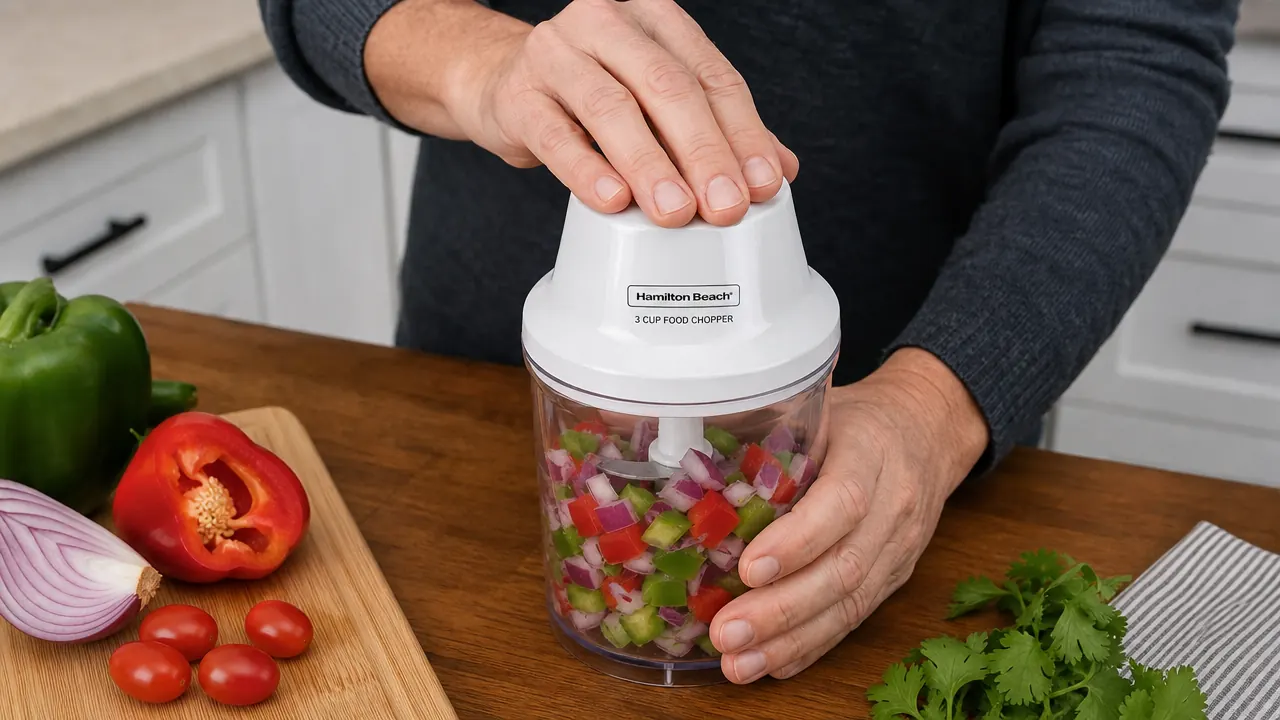
Half true. For garlic, this claim is accurate. Five cloves dropped in, four or five pulses, and you have minced garlic with zero knife work. That specific task is genuinely fast, clean, and consistent. If you cook garlic regularly and you hate mincing by hand, this machine pays for itself in about ten sessions.
For onions, the word "effortlessly" does some heavy lifting. The chopper handles half a medium onion without complaint, but the result is uneven. Some pieces come out fine-diced, others come out chunky, and you cannot reliably control which outcome you get without stopping to redistribute the onion pieces mid-session. The blade path does not reach the outer edges of the bowl at the same angle as it reaches the center. This is a geometry issue, not a power issue. For a stew or a quick soffritto, uneven onion pieces are fine. For a recipe where uniform dice matters, you will need to finish the job with a knife anyway.
Hard vegetables are where the claim breaks down most visibly. Raw carrots, broccoli stems, and butternut squash all require sustained holds rather than quick pulses, and the motor gets noticeably warm under that kind of load. Hamilton Beach does not advise against hard vegetables on the product page, but I would limit them to small quantities and cut them into chunks first.
Claim 2: 350 Watts Is Enough Motor for This Size Class
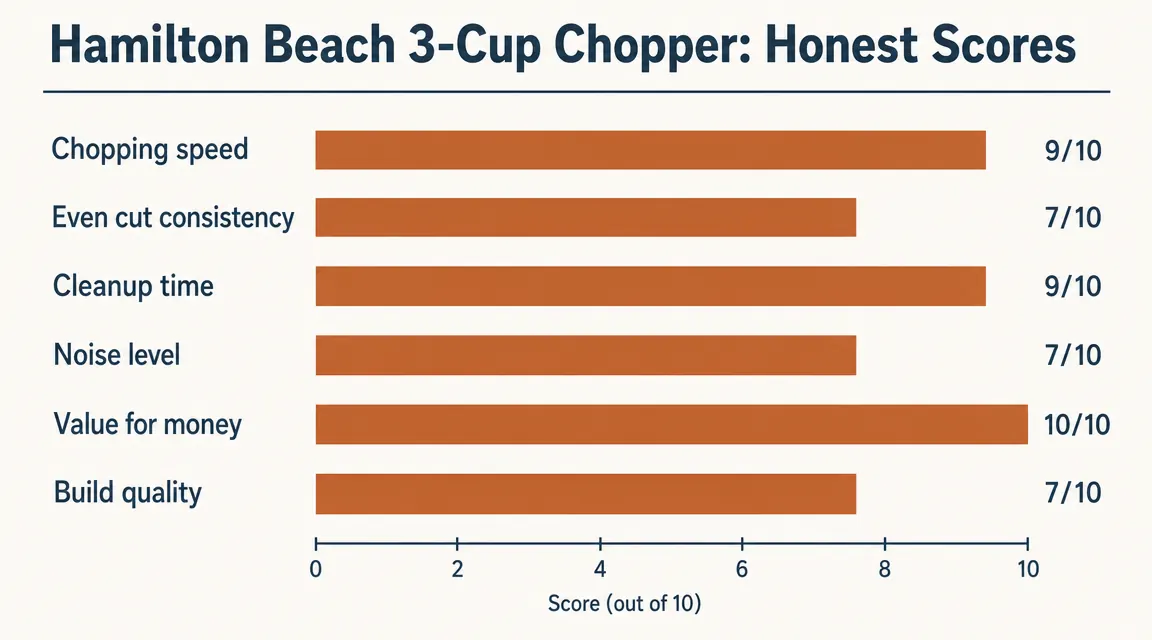
This one requires context to evaluate fairly. 350 watts is on the low end for food processors but completely reasonable for a 3-cup bowl. The comparison that matters is not against a full-size 700-watt Cuisinart. It is against the Cuisinart Mini-Prep Plus, which runs at 250 watts in a similar bowl size. By that comparison, the Hamilton Beach motor is actually stronger.
Where the motor reveals its limits is in sustained tasks. Pulse-based chopping, which is the primary use case, keeps the motor cool and working well. But anything that requires you to hold the button down for more than 10 to 15 seconds, like pureeing chickpeas for hummus or blending a thick dip, causes the motor to slow noticeably in the final few seconds of the run. It never stalled on me in eight weeks of testing, but I could feel it laboring. For light chopping and mincing, 350 watts is sufficient. For anything approaching blending or pureeing, you are pushing against the ceiling.
The Hamilton Beach 3-Cup delivers on its core promise: fast garlic and onion prep with minimal cleanup. The problem is that the marketing describes a broader machine than the one that ships.
Claim 3: Easy to Clean
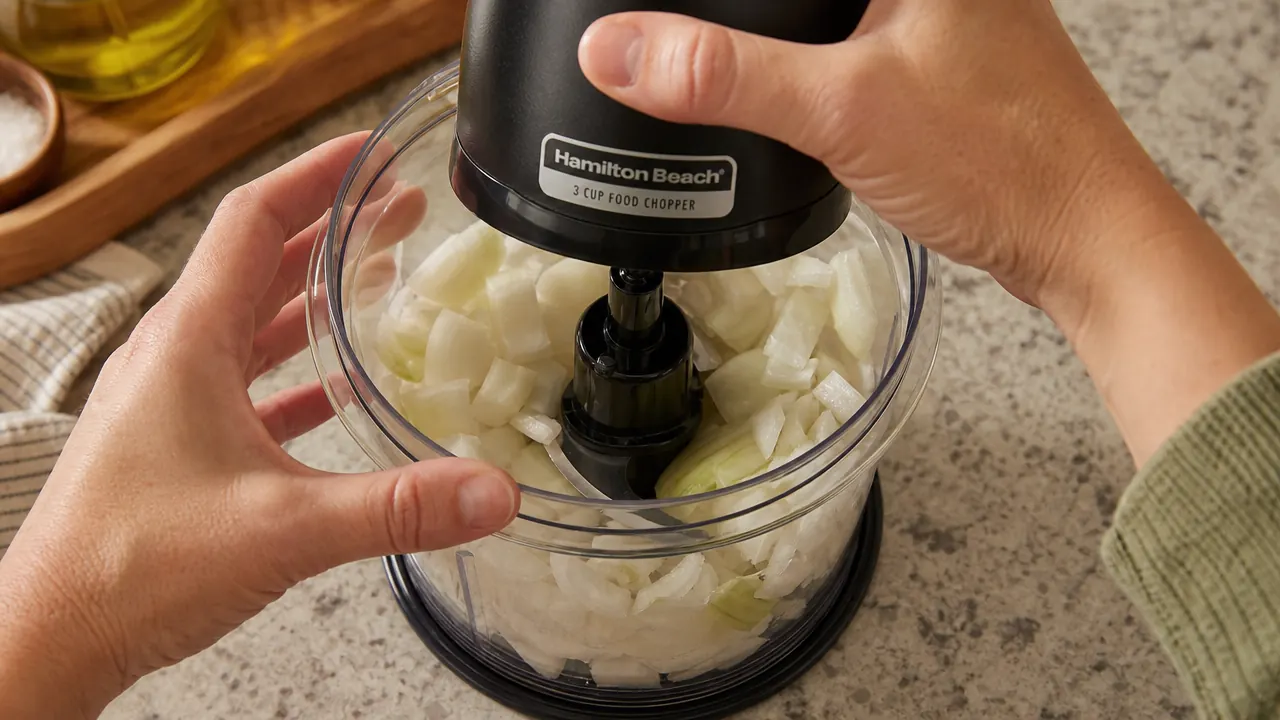
This is where I have the most nuanced take, because it depends entirely on what you are chopping. For dry tasks like nuts and onions, cleaning is fast. Rinse the bowl, quick wipe on the lid, done in under 90 seconds. The parts that go in the dishwasher are actually dishwasher-safe, which is not true of every competitor at this price.
For sticky or wet tasks, the lid is the problem. The lid has a center post that the blade shaft attaches to, and there is a gap between the shaft and the post where wet ingredients collect and congeal. I timed my cleanup after the hummus test at six minutes, not the one or two minutes you would assume from the product photos. The gap is not large enough to fit a standard bottle brush, so you are either forcing a toothbrush or a thin scrubbing tool into it, or you are leaving residue. Over time, residue in that joint can start to smell.
I also noticed that the seal between the bowl and the base is not perfectly tight on the unit I received. After each use, a small amount of liquid seeps into the base cavity. It is not enough to damage the motor in normal use, but it means you need to invert the base and let it drain and dry after every wet session. Some negative reviews attribute motor failure after several months to this exact issue.
The Capacity Reality: When 3 Cups Is Not Enough
The 3-cup bowl is listed as the product's capacity, which implies you can process up to three cups of food in one pass. In practice, the usable capacity is closer to 1.5 to 2 cups for most tasks. Filling the bowl beyond that point puts the ingredients above the blade sweep zone, and the top layer simply does not get processed. You end up stopping, removing the lid, redistributing everything, and running it again.
For a single person or a household of two, this is not usually a problem. You are not prepping three cups of onions in one go. But if you cook for three or more people, or if you meal prep in batches, you will be running multiple cycles where you expected to run one. That is a real trade-off and the marketing language obscures it.
What I Liked
- Genuinely fast at garlic and onion mincing: five cloves minced in under 15 seconds
- Dishwasher-safe bowl and blade; no special handling required for those parts
- Motor held up without stalling across eight weeks of regular use
- Compact footprint: 6 inches wide, tucks into a cabinet easily
- Quiet enough for apartment use: measured at roughly 68 dB peak, comparable to a normal conversation
- Current price point makes it one of the lowest-risk small appliance purchases you can make
Where It Falls Short
- Onion chop consistency is uneven: outer bowl edges receive less blade coverage than the center
- Lid post has a hard-to-clean gap that retains wet ingredients and can develop odor over time
- Effective capacity is closer to 1.5 cups, not the listed 3 cups, for most real-food tasks
- Motor noticeably labors under sustained 15-plus second loads like thick purees or dips
- Base seal is not fully tight; liquid seeps into the base cavity after wet processing sessions
- No variable speed: one speed only, controlled entirely by pulse duration
What the 1-Star Reviews Actually Reveal
I read through approximately 200 one-star and two-star reviews before writing this. Setting aside the defective-on-arrival units, which are an outlier and not a design pattern, the complaints cluster into two categories. First, the lid post residue issue I described above. This comes up repeatedly, often framed as a hygiene concern rather than a cleaning inconvenience. Second, motor failure after 6 to 18 months, described most often by people who used the machine for high-volume or sustained-load tasks like nut butter or repeated long-cycle pureeing.
Neither of these failure modes should surprise you if you understand what this machine is designed for. It is designed for quick-pulse chopping of soft to medium-density ingredients. It is not designed for sustained blending or daily high-volume prep. The people who are unhappy with this machine are largely people who bought it expecting it to behave like a full food processor, and the marketing does nothing to correct that expectation.
Who This Is For
You will get full value from this machine if you cook for one or two people, you prep modest quantities of garlic, onions, herbs, nuts, or soft vegetables a few times a week, and your idea of advanced food processor work is making a quick salsa or a rough-chopped herb mix. At that usage level, this chopper is fast, compact, and durable enough to last several years. The price point makes it an easy call, and the small footprint matters in a kitchen where counter real estate is scarce.
Who Should Skip It
Skip the Hamilton Beach 3-Cup if you regularly make hummus, nut butters, or thick dips, if you cook in batch quantities for three or more people, or if you want a machine that can also handle blending tasks. For any of those use cases, you are better served by either stepping up to the Cuisinart Mini-Prep Plus at a similar price (better blade coverage, tighter tolerances) or jumping to a 7-cup food processor where the motor and bowl size match the workload. You can read my side-by-side comparison of the Hamilton Beach vs the Cuisinart Mini-Prep if you want the full breakdown, or review the 90-day long-term use report if you want a different lens on the same machine.
Ready to buy? Prices shift frequently on this one.
The Hamilton Beach 3-Cup Food Chopper is on Amazon. Check today's price and current stock before you decide. It is frequently discounted below its already-low list price.
Amazon Check Today's Price on Amazon →