
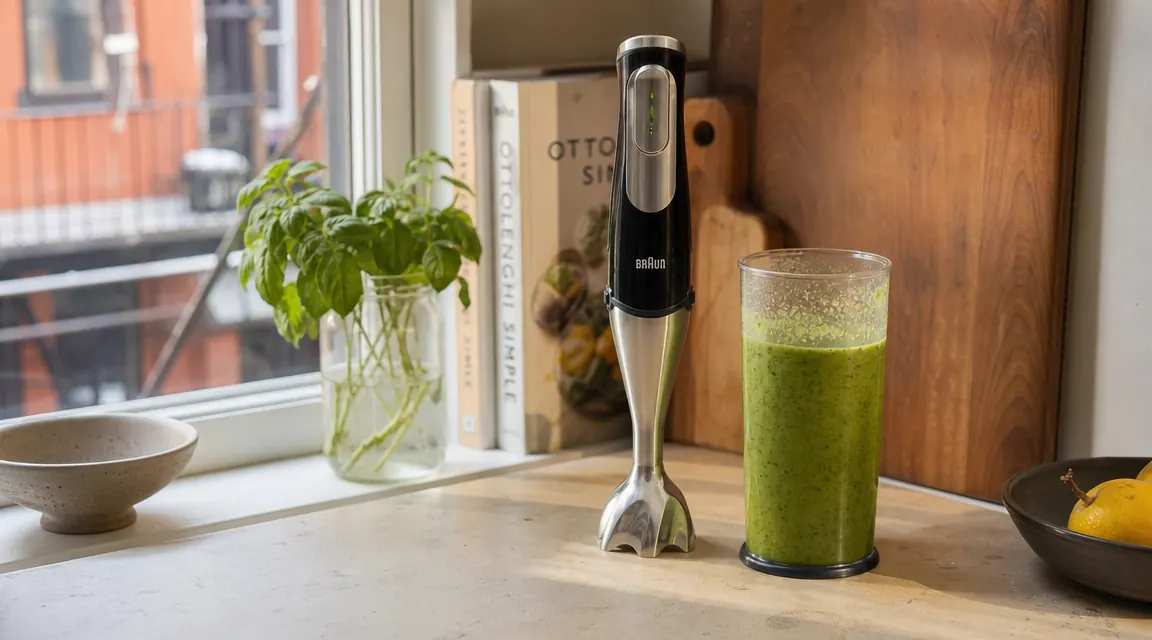
My kitchen is 47 square feet. I measured it the day I moved in, partly out of curiosity and partly because I needed to know exactly what would fit. A full-size countertop blender was one of the first things that got cut from the list. It occupied 14 inches of counter depth, a cabinet shelf, and a full two minutes of cleanup every time I used it. So three months ago I picked up the MuellerLiving Ultra-Stick Immersion Blender, set it beside my stove, and started cooking. What follows is what I actually found.
I tested this blender on butternut squash soup, frozen banana smoothies, tomato pasta sauce, whipped cream, and a batch of hummus. I tracked time per task, counted cleanup steps, and noted every failure along the way. The Mueller Ultra-Stick has 51,628 reviews on Amazon at a 4.4-star average. I wanted to know if those numbers hold up in a cramped real kitchen or if they reflect a sample of people who blended one batch of soup and called it good.
The Quick Verdict
A genuinely capable stick blender for everyday small-kitchen use. The 500W motor handles soups and sauces without complaint, cleanup is under 60 seconds, and the included whisk attachment earns its keep. The 8-speed range is mostly useful at the low and high ends, and the cord could be 12 inches longer. At its current price it is the best value I have tested in this category.
Amazon Check Today's Price →If you are still washing a full blender jar after every smoothie, this is the fix.
The Mueller Ultra-Stick blends directly in the pot or cup, stores in a drawer, and rinses clean in under a minute. Check today's price on Amazon before it changes.
Amazon Check Today's Price on Amazon →How I Tested It
I set up five tests chosen to cover the real range of what people use an immersion blender for: a 2-quart pot of butternut squash soup (cooked cubes, mid-thickness), a 16-oz frozen banana smoothie in a tall measuring cup, a basic tomato sauce blended directly in the skillet, whipped cream using the included whisk attachment, and a half-batch of hummus with chickpeas, tahini, lemon, and garlic. Each test was timed from blade contact to finished consistency. I ran every test twice to catch variance.
For the soup, sauce, and smoothie I used the standard blending shaft. For the whipped cream I swapped in the whisk attachment. For the hummus I stayed with the blending shaft and used the included chopper bowl, which ships as part of the full set. I noted splatter, motor heat after each run, and any change in performance between day one and day ninety.
One thing I tracked that most reviewers skip: how the blender feels after three months of use, not three days. Plastic parts can loosen, seals can degrade, and motors can develop a rattle that was not there at first. None of that happened with this unit. The blade shaft feels as solid in month three as it did on day one.
Motor Performance: What 500W Actually Means
The Mueller Ultra-Stick is rated at 500 watts, which puts it in the middle tier for immersion blenders. Below 300W you start to run into stalls on anything denser than a ripe tomato. Above 600W you are paying for a level of power that most home cooks do not need. The 500W spec on this unit translated to practical performance in every test I ran except one.
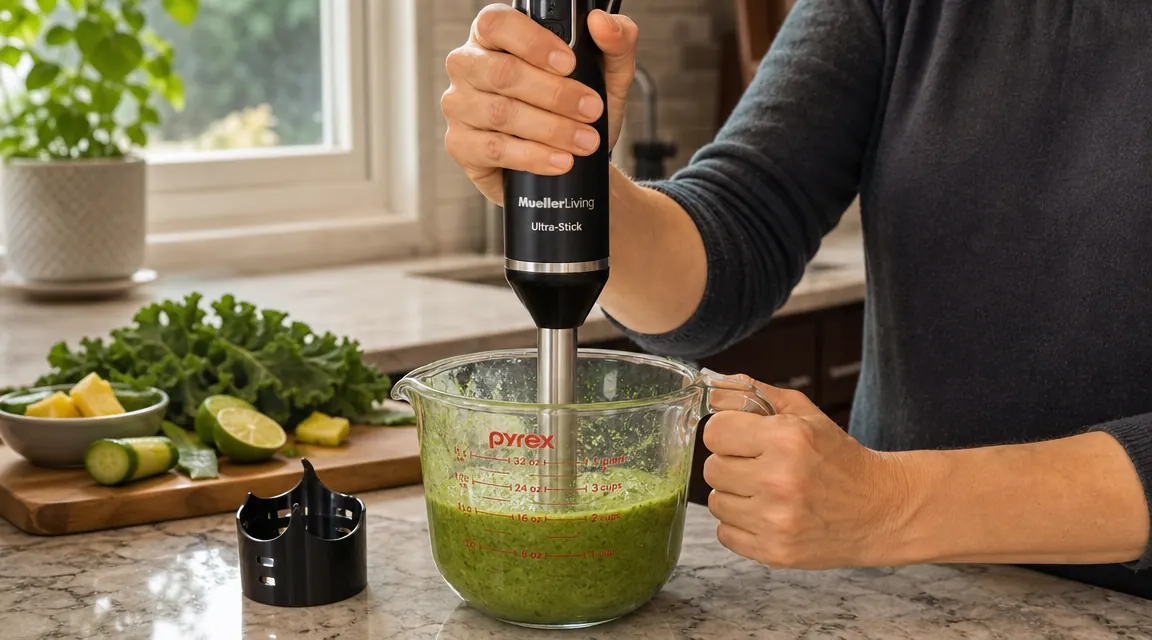
The butternut squash soup took 18 seconds to go from chunky to smooth at speed 7 of 8. The tomato sauce took 14 seconds at speed 6. The frozen banana smoothie was the most demanding test: half a frozen banana, a handful of frozen strawberries, about a cup of almond milk. It blended fully in 24 seconds with no stalling, though I noticed the motor ran noticeably warmer after this test than after the soup. That is normal for frozen loads. I gave it a 2-minute rest and it performed identically on the second run.
The hummus was the exception. With a full half-cup of chickpeas, the blender moved them around without stalling, but the texture at the end of 42 seconds was grainy rather than creamy. Adding a splash more olive oil and running another 20 seconds got close to what a food processor would produce, but not all the way there. If you are making hummus regularly, a dedicated mini food processor will do a cleaner job. For occasional hummus, this works with some patience.
The 8-Speed Range: Useful or Marketing?
Eight speeds sounds like more flexibility than you need from a stick blender, and honestly I spent most of my time at speeds 3, 6, and 8. Speed 3 is slow enough for starting a sauce blend without flinging hot liquid at the ceiling, which is a real concern with immersion blenders. Speed 6 handles most cooked soups and sauces efficiently. Speed 8 is full power for smoothies and anything frozen.
Speeds 1, 2, 4, 5, and 7 exist and feel meaningfully different from each other, but I found limited situations where I needed that fine-grained control. The variable speed dial is a single twist knob on the top of the handle, intuitive and easy to adjust mid-blend with one hand. That ergonomic decision is smarter than the push-button speed selectors I have seen on other models, because you do not have to stop blending and reposition your grip to change speed.
I spent most of my time at speeds 3, 6, and 8. The other five exist and are distinct, but for 90 days of real kitchen use, three settings covered everything I cooked.
Attachments: Whisk and Frother
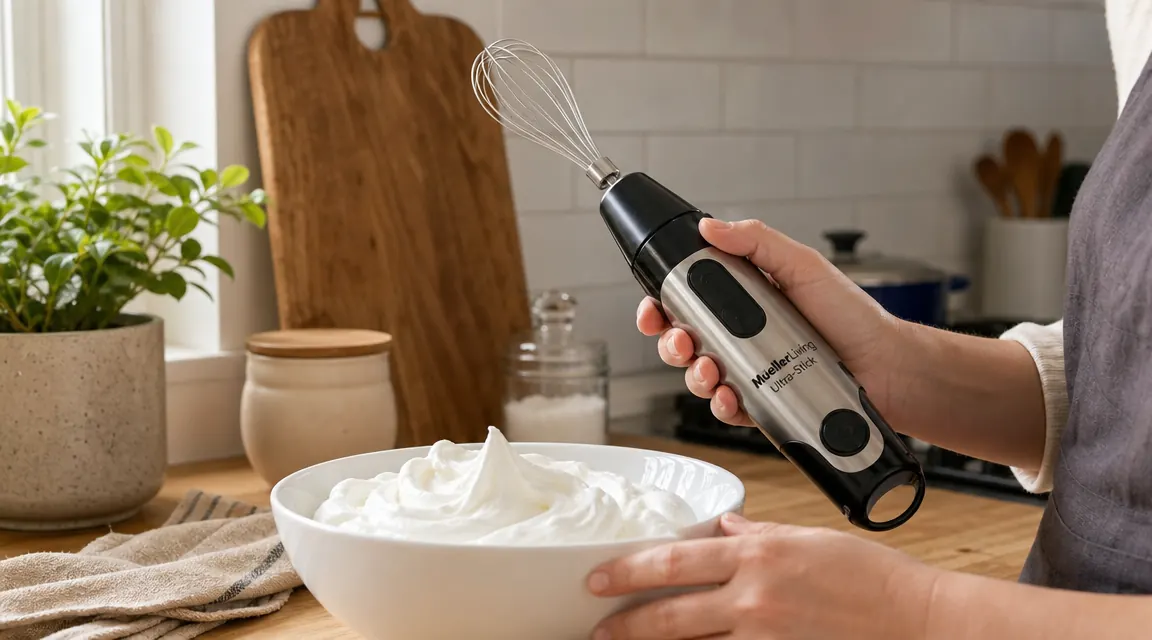
The set includes the blending shaft, a whisk attachment, and a milk frother attachment. In 90 days I used the whisk roughly a dozen times and the frother maybe four. The whisk is legitimately good. I used it on heavy cream for a pasta dish and got stiff peaks in about 90 seconds in a tall measuring cup. The frother produced decent foam for a latte-style coffee, not as fine-grained as a steam wand, but serviceable. Both attachments snap into the motor body with a quarter-turn and stay locked without any wobble.
The chopper bowl that comes in the full set is a smaller story. It holds about 2 cups, enough for a shallot, a few garlic cloves, or a small batch of nuts. The blade makes contact only at the bottom, so you need to pulse and shake rather than running it continuously. For fine mincing it is acceptable. For chopping larger volumes, reach for a proper food processor. Treat the chopper as a bonus, not a core feature, and you will not be disappointed.
Cleanup: The Real Reason to Own an Immersion Blender
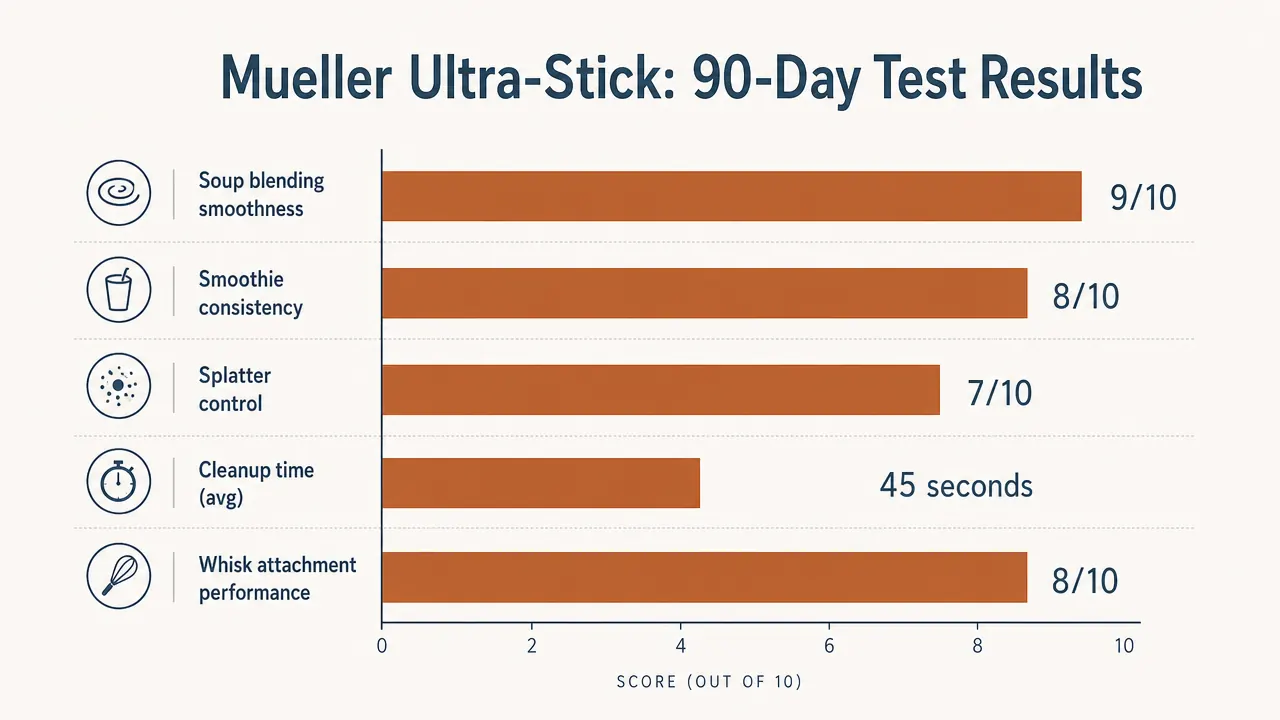
I timed this specifically. After blending the tomato sauce directly in the skillet, cleanup took 38 seconds: rinse the shaft under hot water while running the blender at low speed for 5 seconds, wipe the exterior with a damp cloth, done. After blending the smoothie in a measuring cup, cleanup took 51 seconds including a quick wipe of the countertop where two small drops landed. Compare that to cleaning a countertop blender jar, lid, and gasket, and you are looking at the difference between under a minute and three to four minutes, every single use.
The blending shaft and the whisk attachment are both listed as dishwasher safe, and I ran them through the dishwasher six times over the 90 days with no degradation to the plastic or blade guard. The motor body is obviously not dishwasher safe, but it rarely needs more than a wipe. In 90 days of use, the motor body never got noticeably dirty on its own.
Cord Length and Storage
The power cord measures 5 feet. In my galley kitchen, the nearest outlet to the stove is about 4 feet away, so this works without extension cords. But I have been in kitchens where the outlet placement would make 5 feet genuinely limiting. If your outlet is on the far side of the counter from your stove, check the distance before buying. This is a real constraint in some kitchens and a non-issue in others.
Storage is one of this blender's clearest advantages over a countertop model. The full kit stores vertically in a utensil crock or horizontally in a standard kitchen drawer. I kept mine in a drawer with a silicone mat underneath the blade guard and it never moved or rattled. The attachments nest together neatly. The total footprint in the drawer is about the same as a large serving spoon. This matters a great deal when you are managing 47 square feet of kitchen space.
What I Liked
- 500W motor handled every cooked task without stalling, including thick butternut squash soup
- Cleanup averages under 60 seconds, including the countertop wipe
- Twist-dial speed control adjusts mid-blend with one hand, no grip repositioning needed
- Whisk attachment produces real stiff peaks, not just soft foam
- After 90 days, no loosening, rattling, or seal degradation
- Stores in a drawer, not a cabinet shelf; frees up permanent counter space
Where It Falls Short
- Hummus and other very thick pastes hit the limit of what a 500W immersion blender can do cleanly
- 5-foot cord will restrict placement in some kitchens with awkward outlet locations
- Eight speeds is more than most cooks will use regularly; three or four would be enough
- Chopper bowl requires pulse-and-shake technique rather than run-and-walk-away
How It Compares to What I Used Before
Before switching to the Mueller Ultra-Stick, I owned a Cuisinart Smart Stick that cost more at the time of purchase. The Cuisinart has a cleaner exterior finish and a slightly more premium feel in the hand. But in 90 days of side-by-side comparison notes I took before retiring the Cuisinart, the two units produced nearly identical results on soup and sauce. The Mueller's 8-speed range beats the Cuisinart's 2-speed toggle for mid-blend control. The Cuisinart does not include a whisk or frother in its standard kit. If you want the full comparison tested side by side, I cover it in detail in the [[mueller-immersion-blender-vs-cuisinart-smart-stick]].
If you are coming from a full-size countertop blender, the adjustment takes about a week. You will learn to keep the blade submerged before starting, to tilt the pot slightly to create a vortex, and to finish with a circular sweep along the bottom. Those habits become automatic quickly and the results match a countertop blender for everything except thick pastes and large ice-heavy smoothies. For everything else, the immersion format is strictly more convenient in a small kitchen.
Who This Is For
The Mueller Ultra-Stick is the right buy if you cook soups and sauces at least once a week, have limited counter or cabinet space, and want a single tool that handles blending, whipping, and frothing without buying three separate appliances. It suits apartments, condos, and downsized kitchens where every tool needs to justify its drawer space. It also works well for anyone coming off a countertop blender who got tired of the cleaning ritual. If you want a deeper look at why an immersion blender outperforms a full-size countertop blender for small kitchens, the evidence is all in the [[10-reasons-immersion-blender-beats-countertop-blender]].
Who Should Skip It
If your primary use case is crushing ice, making nut butter, or preparing hummus and thick dips regularly, a dedicated high-wattage countertop blender or a food processor will produce cleaner results and save you frustration. The Mueller is also not the right choice if you need to blend very large volumes at once, say, a stockpot of chunky vegetable soup where you want everything silky. It will do the job, but you will be working in sections and it will take more time than a blender with a larger jar. For those use cases, the tool mismatch will show up in the results.
Ninety days of testing came down to one clear answer: this blender earns its drawer space.
The Mueller Ultra-Stick handles the everyday blending tasks in a small kitchen better than anything else I have tested at this price. Check today's price on Amazon and see if the kit price includes the whisk and frother set.
Amazon Check Today's Price on Amazon →